
Claiming yet again that he solved the conflict between India and Pakistan, United States President Donald Trump has said that 'no one in history is more deserving than him' of the Nobel Peace Prize, as he criticised former President Barack Obama for getting the honour even though he 'didn't do anything'.
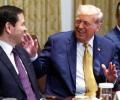
Rubio also listed the peace deal between the Democratic Republic of the Congo and Rwanda, 'a 12-day war that ended with an American operation that we're the only country in the world that could have done, hopefully pretty soon a peace deal between Azerbaijan and Armenia.'

Stressing that wars are "very bad", Trump said that he seems to have "an ability to end them, to get people together" for which he uses the "power of the United States".

By all available indications, the White House drafted a face-saving note and handed it, ready-made, to Islamabad. Pakistani Prime Minister Shehbaz Sharif was supposed to then post it in the guise of a plea urging Trump to extend the deadline by two weeks 'to allow diplomacy to run its course'. Trump would then graciously accept Pakistan's 'request' and declare a ceasefire. Sharif dutifully posted the message on X. Except that he, or whoever was handling the account, forgot to delete the tell-tale first line visible in the edit history: 'Draft - Pakistan's PM Message on X'. Prem Panicker's must read blog on the Iran War.

Prime Minister Narendra Modi stayed calm, avoided public confrontation, and focused on India's long-term interests to steady ties with the United States.
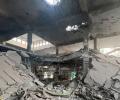
The Pakistan Army has criticized recent remarks by Indian military officers and political leaders, warning that a future conflict between the two countries could lead to "cataclysmic devastation." The statement follows comments from Indian officials regarding India's ability to cross borders and the potential for military action against Pakistan.

Trump has made it clear: the US will not lift its blockade of Iranian ports until a deal is signed.

High energy costs, long a drag on India's manufacturing competitiveness, are finally easing. Power and fuel expenses accounted for 1.98 per cent of net sales in 2024-25, the lowest level in data compiled by the Centre for Monitoring Indian Economy (CMIE) over the past two decades.
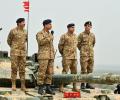
'Can a nuclear-armed nation sustain itself indefinitely under overt military rule without catastrophic consequences for itself and the region? History suggests otherwise.'

'The entire US ecosystem built over decades at the bases in the Gulf region, especially the UAE, costing trillions of dollars have been decimated, dealing a mortal blow to the US Central Command's war capability,' points out Ambassador M K Bhadrakumar.

Asim Munir, who was promoted to the Field Marshal rank this year, will also simultaneously hold the office of the Chief of Army Staff, along with his duties as CDF.
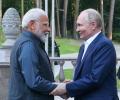
The Indian government is dealing with the matter having in mind the national interests of this country in the first place, he said.

One key development is the direct cargo connection between Chennai and Vladivostok, a crucial Russian port on the Northern Sea Route.

An anti-graft panel in Bangladesh has launched an investigation against former prime minister Sheikh Hasina and her family in connection with the allegations of embezzling $5 billion in the Rooppur nuclear power plant, according to a media report.

The core issues to be settled -- access to Hormuz, Israel's aggression in Lebanon, the question of Iran's nuclear programme, sanctions relief and compensation -- are thorny enough to require weeks of patient negotiation. The most likely outcome of the opening sessions is that both sides take the measure of each other, establish what is and is not negotiable, and return home without having broken anything. That would count as progress.

Two 'very smart' leaders of India and Pakistan decided to end last month's conflict that could have turned into a nuclear war, United States President Donald Trump said after holding a rare luncheon meeting with Pakistan army chief Field Marshal Asim Munir at the White House.

India has abstained in the UN General Assembly on a resolution that demanded that Russia immediately cease its aggression against Ukraine and urgently withdraw its military and other unauthorised personnel from the Zaporizhzhia nuclear power plant.

Pakistan's ambassador to Russia, Muhammad Khalid Jamali, has warned that Pakistan will respond with "full spectrum of force", including nuclear, if it is attacked or its vital water flow is disrupted. The warning comes amid heightened tensions between Pakistan and India following a terrorist attack in Jammu and Kashmir. Jamali also reiterated Pakistan's stance on the Indus Water Treaty, saying any attempt to stop or divert water flow would be considered an act of war. He urged de-escalation, emphasizing the potential danger given both countries possess nuclear weapons. Jamali further called for a neutral investigation into the Kashmir attack, suggesting the involvement of China and Russia. He also highlighted the need to address the root causes of the conflict, pointing to the unresolved Kashmir issue and its potential for resentment.

The Dhurandhar movies will undoubtedly shape the minds of the audience much more than news reports, court investigations, books and documentaries. But it is worth remembering that Pakistan's irridentist claims against India's national security have succeeded due to strategic planning, diplomacy, and the unsung heroines and heroes across government agencies, not due to a single maverick leader, points out Shweta Desai.But it is worth to remember that Pakistan's irredentist claims against India's national security have succeeded due to strategic planning, diplomacy, and the unsung heroines and heroes across government agencies -- not a single maverick, points out Shweta Desai.
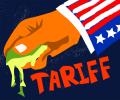
A trade deal makes sense only if it is fair and reciprocal. If the cost is strategic dependence or loss of policy space, waiting is the wiser option, asserts Ajay Srivastava.

...reopen for up to six months. Until then, the Strait stays nearly closed. The world pays. And no one, including the man who started this, can say when it ends, notes Prem Panicker in his must read blog on the Iran War.

India's second nuclear-powered ballistic missile submarine was commissioned into the Navy on Thursday in the presence of Defence Minister Rajnath Singh who said this will further strengthen the country's nuclear triad and enhance nuclear deterrence.

'The next two to three weeks will not be decided in Washington.' 'They will be decided in Tehran, in whatever calculation Iran makes about the costs of continued resistance against the costs of appearing to have yielded.'

If the Iranian regime needs to be punished for promoting quasi-terrorist outfits like Hezbollah and Hamas, then what about Pakistan which has spent decades exporting terror around the world, killing thousands, particularly in Afghanistan and India? asks M R Narayan Swamy.

For weeks, the war skirted the edge of catastrophe without tipping over. Missiles flew, there was much destruction, commanders were assassinated, cities across the Gulf and even in Israel struggled to absorb the shock. But one line held: Energy infrastructure, the arteries of the global economy, remained largely untouched. That is no longer true. Prem Panicker continues his must read daily blog on the Gulf War.

The US Navy seized an Iranian-flagged cargo ship in the Gulf of Oman, escalating tensions as ceasefire talks face uncertainty. The incident raises concerns about the fragile ceasefire and the ongoing blockade of the Strait of Hormuz.

Afghans have deep self-respect and are the last people to put up with humiliation. Is it any surprise that relations between Afghanistan and Pakistan have touched an all-time low and the two countries are now at war? asks M R Narayan Swamy.
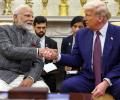
The new US national security strategy signals a retreat from global dominance while reaffirming continuity in India's role in Indo-Pacific security and Quad cooperation, points out former foreign secretary Shyam Saran.

The delegations from the US and Iran head to Islamabad on Friday, carrying a ceasefire that is already fraying, a Strait that is technically open and practically closed, and a negotiating agenda that would challenge even parties actually negotiating in good faith, which these groups are not. Prem Panicker continues his must read blog on the Iran War.
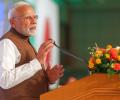
Showcasing India as an attractive investment destination, Modi said the country has political and economic stability as well as transparency and predictability in policy decisions.

Trump may strike. He may announce productive talks and extend again. He may do both at the same time. Iran will not open the Strait on someone else's terms, so no matter what happens, that problem will remain unsolved. And the IRGC will still be collecting its $2 million toll from every ship bold enough to ask permission to pass.

The LPG squeeze on India's restaurant sector is the quotidian face of a deeper crisis.

Trump has repeatedly claimed that he "helped settle" the tensions between India and Pakistan and that he told the nuclear-armed South Asian neighbours that America would do a "lot of trade" with them if they stopped the conflict.

Alliances fight wars effectively only when they share an endgame. If Israel acted without US knowledge, then the military alliance is operating without real coordination at the level of strategic targeting. Neither picture is reassuring in a war that is no longer regional in its consequences. Prem Panicker continues his must read daily blog on the Gulf War.

The Union Budget for 2026-27, presented by Finance Minister (FM) Nirmala Sitharaman on Sunday, which was a first, had an excellent domestic macro backdrop. According to the first advance estimates, gross domestic product (GDP) in constant prices is projected to grow 7.4 per cent in the current financial year, against 6.5 per cent in 2024-25.

Vice President Jagdeep Dhankhar on Thursday questioned the judiciary setting a timeline for the President to take decisions and act as a "super Parliament", saying the Supreme Court cannot fire a "nuclear missile" at democratic forces.

'Geopolitically and diplomatically it's a very difficult situation for India.'

Fight on toward goals that keep receding, or exit with most objectives unmet. Trump is agitated, his poll numbers falling below the Plimsoll line, his base fractured between those who back the war and those who remember that he campaigned on ending them.

What we are watching is something different: A fog manufactured and maintained by the people who started the war, so that the question of why it was started never has to be answered, observes Prem Panicker in his must read blog on the war in the Middle East.
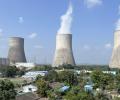
In a significant move, the United States on Wednesday removed restrictions on three Indian nuclear entities, over a week after National Security Advisor Jake Sullivan announced that Washington was finalising steps to 'remove' hurdles for civil nuclear partnership between Indian and American firms.
